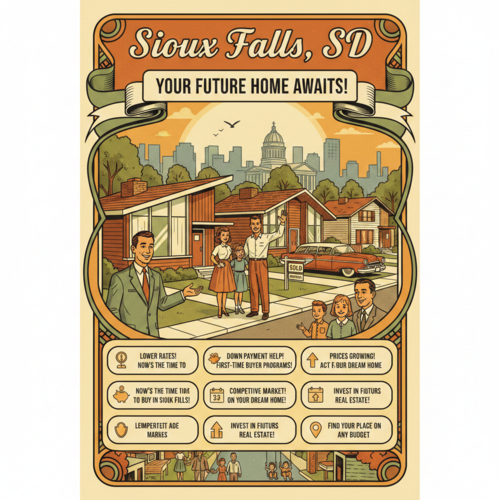





If you've been watching the Sioux Falls real estate market, you've likely noticed something interesting: while national headlines scream about affordability crises and frozen markets, our corner of South Dakota continues to hold its own with quiet resilience. Here's a clear-eyed look at where the market stands and what it means for you.
The Big Picture: A Market Finding Its Balance
The Sioux Falls metro area is entering 2026 from a position of measured stability. After several years of pandemic-era price surges followed by rate-driven slowdowns, the market has settled into a more predictable rhythm — and that's actually good news for both buyers and sellers who know how to read it.
According to data tracked by the REALTOR® Association of the Sioux Empire (RASE), the median home price in the Sioux Falls metro area is currently hovering around $326,000, reflecting modest year-over-year appreciation in the range of 1.4% to 3.7% depending on the price segment. That's not the explosive growth of 2021, but it's steady, sustainable equity-building — exactly what a healthy market looks like.
Inventory: More Options, But Still Competitive
One of the most talked-about shifts in the Sioux Falls market right now is inventory. We're sitting at approximately 3.8 months of supply, which puts us in a transitional zone between a seller's market (under 3 months) and a balanced market (around 6 months).
What does that mean practically? Buyers have more choices than they did 18 months ago — and less pressure to waive every contingency just to get an offer accepted. However, don't mistake "more inventory" for "easy pickings." Well-priced, move-in ready homes in desirable areas are still moving quickly, often within the first one to two weekends on market.
Where Inventory Is Tightest
The sub-$300,000 price range remains the most competitive segment in Sioux Falls. First-time buyers and investors are competing for the same limited pool of affordable homes, which means buyers in this range should still expect multiple-offer situations and need to come in prepared. Above $350,000, buyers have more negotiating room and are seeing longer days on market — sometimes an opportunity to negotiate on price or seller concessions.
Mortgage Rates: The Elephant in the Room
There's no dancing around it — mortgage rates remain a significant factor shaping buyer behavior in Sioux Falls. Rates that hovered in the 6.5% to 7% range through much of late 2025 have moderated slightly heading into early 2026, but they're nowhere near the sub-3% environment that many buyers still remember fondly.
Here's the reframe that matters: buyers who purchased in Sioux Falls even at today's rates are building equity in a market that hasn't seen the dramatic corrections hitting coastal metros. And with the potential for refinancing as rates normalize over the next few years, buying now means locking in today's price before further appreciation. Waiting for rates to drop dramatically could mean competing against a wave of sidelined buyers — and paying more for the same home.
Neighborhood Spotlights: Where the Action Is
The Sioux Falls market isn't monolithic — trends vary meaningfully by area, and knowing where to focus can make or break a buyer's strategy.
South Sioux Falls
The south side of the city continues to be a hotbed of new construction activity. Developments in areas like Prairie Hills and surrounding corridors offer buyers the opportunity to purchase new builds with builder incentives — sometimes including rate buydowns that soften the sting of today's mortgage environment. For sellers in established south-side neighborhoods, new construction nearby means your home needs to be competitively priced and well-presented to stand out.
Brandon and Harrisburg
The suburbs of Brandon and Harrisburg remain magnets for growing families looking for more space at a slightly lower price per square foot than closer-in Sioux Falls neighborhoods. Both communities have seen steady demand driven by their school districts, newer housing stock, and relative affordability. Inventory in these markets tends to be tighter than the broader metro, so buyers eyeing the suburbs should be ready to move decisively.
Tea and Beyond
Tea, South Dakota continues its steady growth story, attracting buyers priced out of closer-in options who are willing to trade a longer commute for a newer home at a more accessible price point. As the metro expands, these outer-ring communities are becoming increasingly mainstream choices rather than a fallback option.
Help for Buyers: Down Payment Assistance Is Real and Available
One of the most underleveraged resources in this market is the South Dakota Housing Development Authority (SDHDA) and its suite of buyer assistance programs. First-time buyers — and even some repeat buyers who haven't owned a home in the past three years — may qualify for:
- Fixed-rate mortgage programs through SDHDA at competitive rates
- Down payment assistance that can cover a significant portion of the typical 3-5% down payment requirement
- Governor's House Program options for qualifying buyers
These programs are income and purchase-price limited, but for buyers targeting homes in the sub-$300K range, they can be a genuine game-changer. Many buyers don't realize they qualify until they sit down with a knowledgeable local lender or real estate agent. If you haven't explored these options, it's worth a conversation before you assume homeownership is out of reach.
What Sellers Need to Know Right Now
If you're thinking about listing in 2026, the market is rewarding sellers who are strategic — not just those who throw a sign in the yard and hope for the best.
Pricing is everything. Overpriced homes are sitting. The days of pricing 10% above comparable sales and expecting multiple offers are behind us in most segments. Buyers are more educated than ever, and an overpriced listing will generate weak traffic and lead to price reductions that actually hurt your final sale price.
Presentation matters more now. With inventory up, buyers have options. Homes that are well-staged, professionally photographed, and marketed across digital platforms consistently outperform those that aren't. This isn't optional anymore — it's the baseline expectation for attracting serious buyers.
The right timing still exists. Historically, the Sioux Falls market sees a surge in buyer activity from late February through June. Sellers who list in that window typically see stronger showings and faster sales. If you're considering a spring listing, now is the time to start your pre-listing preparation — not the week you want to go live.
The Bottom Line: A Market That Rewards the Prepared
The Sioux Falls housing market in early 2026 is neither a buyer's paradise nor a seller's windfall — it's a market that rewards preparation, local knowledge, and realistic expectations on both sides of the transaction.
For buyers, that means getting pre-approved, understanding assistance programs, and being ready to act when the right home hits the market. For sellers, it means pricing strategically, presenting your home exceptionally, and partnering with an agent who knows this market inside and out.
Sioux Falls continues to be one of the more resilient housing markets in the upper Midwest, with strong employment fundamentals, population growth, and a quality of life that keeps demand healthy even when national conditions soften.
Ready to make your move in the Sioux Falls market? Whether you're buying your first home, upgrading to a larger space in Brandon or Harrisburg, or thinking about listing your current property, I'd love to help you navigate what's happening right now with current, local market data. Reach out to schedule a no-pressure consultation — let's talk about what this market means specifically for your goals.
Check out this article next